
Why Russian Speakers Struggle With English Pronunciation: A Practical Guide
CEFR Level: B1–B2
Category: Pronunciation | Speaking Skills

Many Russian learners ask:
“Why is English pronunciation so strange?”
The truth is simple: English spelling is NOT phonetic. The same letters can sound different, and different letters can sound the same. For Russian speakers, this becomes even more challenging because Russian and English sound systems are very different.
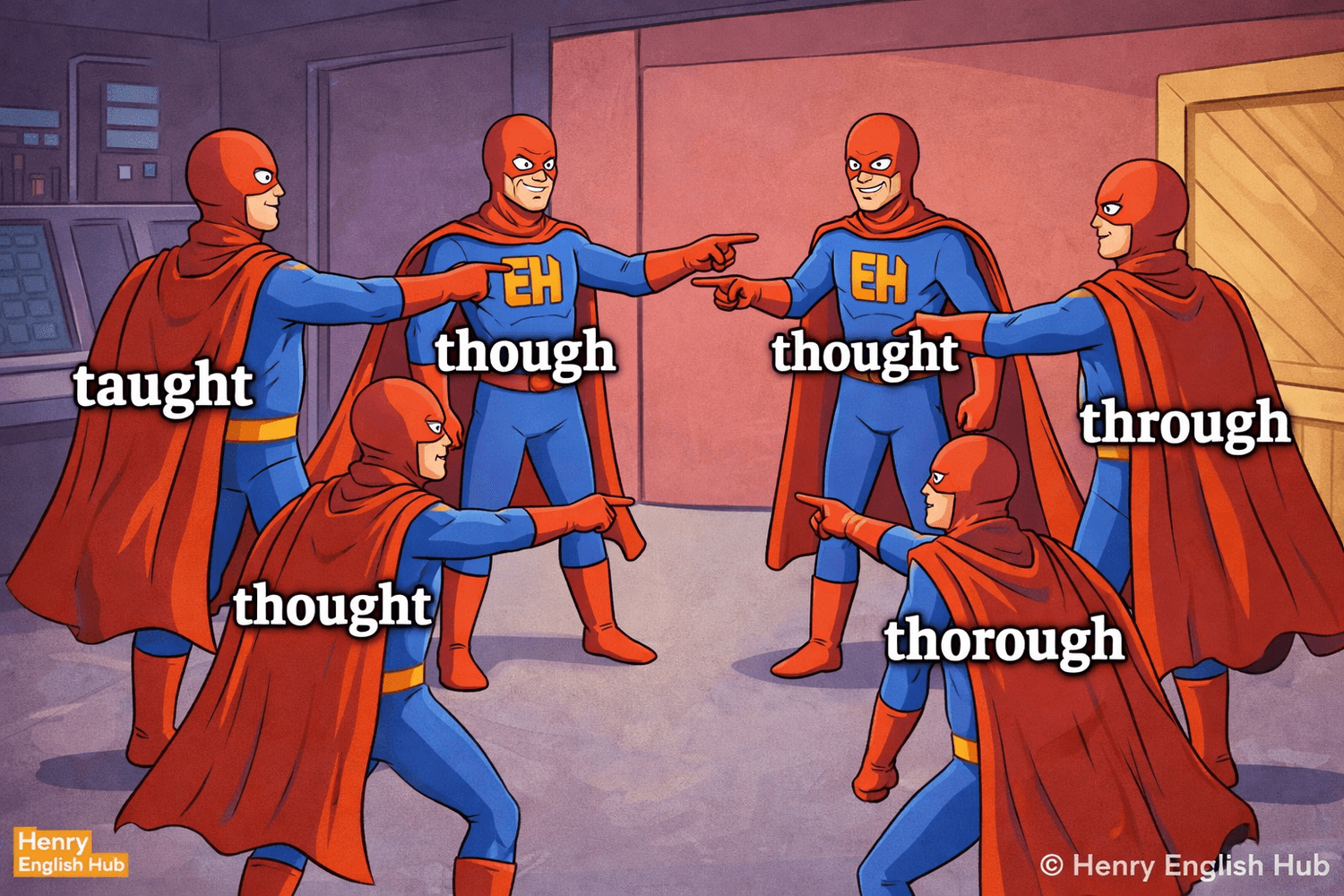
This post explains the most common pronunciation difficulties for Russian learners — including TH, W/V, silent letters, stress patterns, and similar-sounding vowel pairs like ship/sheep. We’ll also explain the Spider-Man meme (the “tough / though / thought / through / thorough” nightmare), and help you understand why these words look similar but sound completely different.
📘 Vocabulary Builder
pronunciation – the way we say words
phonetic – written the same way it sounds
vowel – a, e, i, o, u sounds
stress – which syllable is stronger in a word
voiced – made with vibration in the throat
voiceless – made without vibration
syllable – a beat in a word (ex-am-ple = 3 syllables)
accent – the way someone speaks in a language
silent letter – a letter we write but do not say
intonation – the music of your voice when speaking
💬 Useful Idioms (B1–B2)
Break the ice – start speaking more comfortably
Practice makes perfect – the more you practice, the better you become
A piece of cake – something very easy
Lose your voice – be unable to speak clearly
Sound like a broken record – repeat the same mistake often
🛤️ Why Russian Speakers Struggle With English Sounds
English pronunciation can feel like a puzzle — especially when words that look similar sound completely different. Russian learners often face specific problems because Russian has strong consonants, clear vowels, and no silent letters, while English is full of exceptions.
Let’s explore the most common challenges.
🔹The “TH” Sound (θ / ð)
This is the number one difficulty for Russian learners. The TH sound does not exist in Russian, so learners often replace it with S, Z, T, or D.
Examples:
think → sink or tink
this → zis or dis
Correct pronunciation:
θ = mouth slightly open, tongue between teeth
think /θɪŋk/ð = same position, but voiced
this /ðɪs/
Tip: Put your tongue between your teeth and blow air.
🔹 2. W vs V
Russian has V, but not W.
This creates the classic mistake: Ve vill go to ze vorld.
V = teeth on bottom lip: very /ˈveri/
W = rounded lips like a small “O”: world /wɜːld/
Practice contrast:
wine vs vine
west vs vest
🔹 3. Vowel Confusions (ship/sheep, beach/bitch)
Russian has fewer vowel types, so English vowel contrasts feel difficult.
Common pairs:
ship /ʃɪp/ vs sheep /ʃiːp
live /lɪv/ vs leave /liːv/
full /fʊl/ vs fool /fuːl/
General rule:
Short vowel = relaxed mouth
Long vowel = wider smile or rounded shape
🔹 4. “-ed” Endings
Russian learners often pronounce -ed as /ed/ every time, but English has three endings:
/t/ after voiceless sounds: worked /wɜːkt/
/d/ after voiced sounds: played /pleɪd/
/ɪd/ after T or D: wanted /ˈwɒntɪd/
🔹 5. Word Stress Differences
Russian stress can fall anywhere and changes meaning, but English stress is fixed.
Examples often mis-stressed by Russians:
comfortable → ✔ COM-fort-a-ble /ˈkʌmfətəbəl/
vegetable → ✔ VEG-e-ta-ble /ˈvedʒtəbəl/
interesting → ✔ IN-trest-ing /ˈɪntrəstɪŋ/
Incorrect stress makes the word difficult to understand.
🔹 6. Silent Letters
Russian has no silent letters — English has many.
Common examples for Russian learners:
knight /naɪt/ (K is silent)
climb /klaɪm/ (B is silent)
listen /ˈlɪsən/ (T is silent)
honest /ˈɒnɪst/ (H is silent)
through /θruː/ (GH is silent)
Silent letters “break the logic,” but they must be memorised.
🔹 7. Hard Consonants & the Rolled “R”
Russian uses a hard, rolled R, but English R is soft and smooth.
Russian R = rrrrrr (rolled)
English R = lips round, tongue doesn’t touch the roof
red /red/
right /raɪt/
Russian learners often sound “strong” or “sharp” because many English consonants are softer.
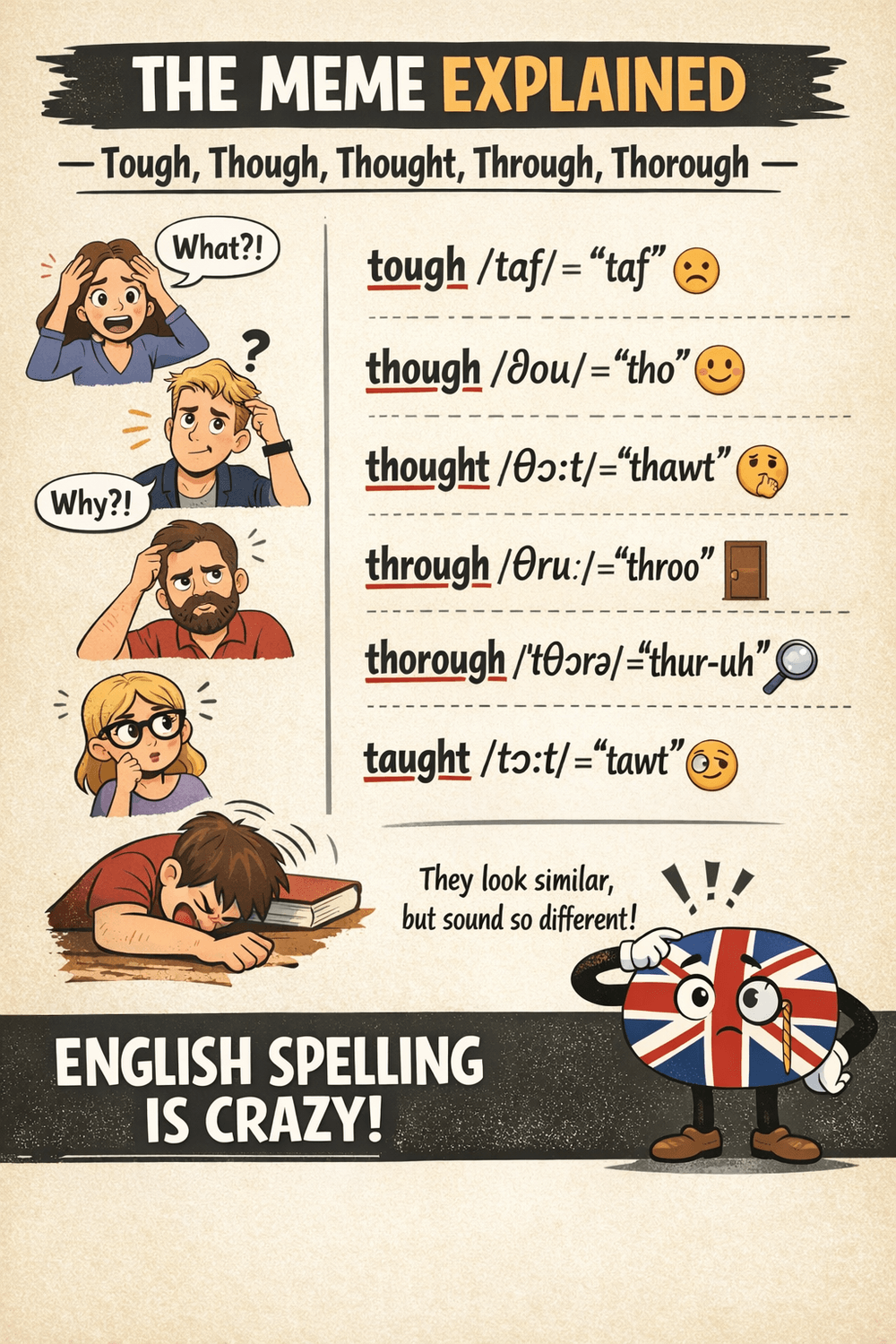
🔹 8. The Meme Explained: tough, though, thought, through, thorough
These words look similar but have different origins and vowel sounds:
tough /tʌf/ = “ф” sound
though /ðoʊ/ = “оу”
thought /θɔːt/ = “о:”
through /θruː/ = “ру:”
thorough /ˈθʌrə/ = “ара”
taught /tɔːt/ – not even spelled the same way!
The meme is famous because even native speakers agree:
English spelling is crazy.
📝 Comprehension Quiz
✔ True or False
1. Russian speakers often replace TH with S or Z.
2. English R is rolled, like in Russian.
3. Silent letters are common in English.
4. “Ship” and “sheep” have the same vowel sound.
5. Word stress is always the same in Russian and English.
✔ Multiple Choice
6. Which sound does NOT exist in Russian?
a) V
b) TH
c) B
7. What is the correct ending pronunciation for “worked”?
a) /ed/
b) /t/
c) /d/
8. Which pair of words is commonly confused?
a) cat / dog
b) ship / sheep
c) tea / tree
9. In which word is the T silent?
a) time
b) listen
c) water
10. English R should be:
a) rolled
b) tapped
c) smooth and soft
⭐ Answer Key
T/F: 1) T, 2) F, 3) T, 4) F, 5) F
MCQ: 6) b, 7) b, 8) b, 9) b, 10) c
🗣️ Discussion Questions
1. Which English sound is the most difficult for you?
2. Do silent letters make English easier or harder?
3. Why do you think English spelling is so irregular?
4. How do pronunciation mistakes affect communication?
5. What strategies help you improve your accent?
Ready to take your English to the next level?
🎓 Join the B2 English Journey: Ascent Course at Henry English Hub — and unlock grammar, fluency, and real communication skills.
👉 Visit Henry English Hub for more grammar guides, comprehension lessons, and vocabulary builders made for adult learners.
Real English. Real Stories. Learn, Think, Fly.
©2025 Henry English Hub. All rights reserved.


HEY, I’M HENRY
Hi, I’m Henry Lilienfield, a TEFL veteran with teaching experience across China, Taiwan, Oman, Saudi Arabia, Iraq, South Africa, and online. With a law degree, two post-grad qualifications in Education Management and Development Studies, and a Level 5 TEFL Diploma, I bring deep knowledge and a practical approach to everything I teach—whether it’s English lessons or how to start your own online teaching business.


JOIN MY MAILING LIST
© Henry English Hub 2025 -www. henryenglishhub.com